C.R. Bradley
The Pale HorseC.R. Bradley is the financial and legal intermediary in the murder-for-hire operation connected to The Pale Horse. Behind the respectable appearance of a Birmingham commission agent, he turns a commission into a wager and helps insulate the people who arrange deaths from the means by which they are carried out. His role is carefully limited: he handles clients and money, but says he does not know what happens elsewhere in the organization.
Identity and Introduction
Mark Easterbrook reaches Bradley through information passed on by Poppy, who supplies his name and address: 78 Municipal Square Buildings in Birmingham. Mark is unsure whether Bradley even exists until he finds the address in a large office building. On the third floor, a ground-glass door bears the name C.R. Bradley, Commission Agent, with an invitation to enter. The sign makes a businesslike first impression before Mark has learned what business is being conducted.
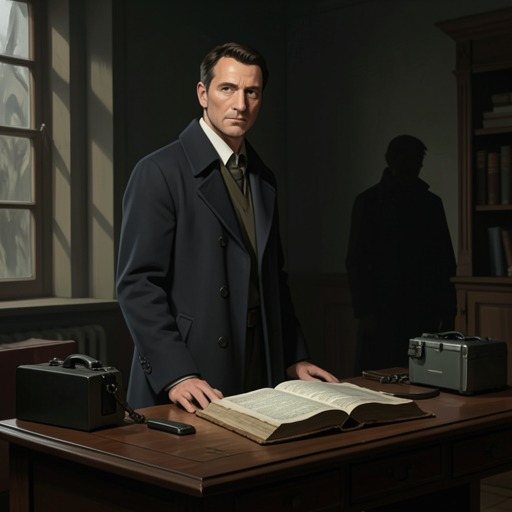
Bradley receives Mark in a private inner office furnished with a desk, comfortable chairs, a telephone, and box files. He is described as a small, dark man with shrewd eyes, dressed in a dark business suit and giving an impression of respectability. That conventional setting and manner contrast with the criminal arrangement he explains. Bradley is also identified as a debarred solicitor, a detail that connects his legal knowledge to his place in the operation without making him its overall director.
The Client-Facing Business
When Mark hints that he has come through an indirect chain of acquaintances, Bradley treats such referrals as ordinary: many clients, he says, arrive through personal connections because their problems are delicate. He calls himself a turf commission agent and steers the conversation toward horses. The language of betting gives the transaction a familiar commercial surface, while leaving the actual purpose unspoken until Bradley is satisfied about what Mark is seeking.
Bradley describes the arrangement as a wager on whether a particular person will die within a stated period. He is usually pessimistic about the person's survival; the client is usually more hopeful. If Bradley wins, the money must be paid promptly, or something unpleasant may follow. Thus the client appears, in the transaction Bradley presents, as the other party to a bet rather than as someone openly paying for a killing. The wager also gives Bradley a financial role that can be separated from the rest of the crime.
The Pale Horse supplies a different part of the client’s experience. After visiting Bradley, a prospective client goes there to see a performance by Thyrza Grey and her associates, intended to impress. Bradley explains that Thyrza is the ruling presence at The Pale Horse but not the organization’s real brain. He handles its financial and legal side, is paid handsomely, and claims to know nothing about what happens beyond his own department. The division leaves each participant with a bounded task rather than a complete view of the enterprise.
Legal Cover and Compartmentalization
Bradley’s pitch to Mark relies on the supposed difficulty of prosecuting a killing attributed to occult powers. He argues that even a confession by the woman claiming to cause deaths remotely would be legally useless, and that such a killing would not count as murder in court. Mark understands the reassurance as part of Bradley’s sales argument: unlike hiring someone to kill with a conventional weapon, commissioning an occult act would, Bradley suggests, not make the client an accomplice. This is Bradley’s claim about the law, not an independent ruling established by the narrative.
The wager and the occult performance work together as forms of concealment. The client encounters a bet and a staged demonstration, while Bradley presents himself as the agent handling the financial and legal arrangements. His explanation makes clear that the surface story is designed to make the underlying crime seem difficult to prove; it does not show that Bradley knows how the deaths are physically caused. Indeed, he stresses that he has no knowledge of the operation beyond his own role.
Place in the Murder Network
The wider scheme’s practical method depends on other people and ordinary points of access. Bona fide employees of consumer-research organizations canvass neighborhoods with questionnaires about household preferences, including bread, cosmetics, laxatives, tonics, sedatives, and indigestion remedies. Their answers can reveal which everyday preparations a prospective victim uses. A separate operative can then pose as a porter, meter reader, plumber, electrician, or other workman, carrying apparent credentials and substituting a preparation for a similar household product. The victim may continue using it for days before illness appears, with little reason to suspect an article used routinely.
Bradley is not identified as the person who conducts those visits or makes those substitutions. His importance lies instead in the financial and legal compartment of the enterprise: he brings prospective clients into a betting arrangement and helps keep their connection to the intended death at a distance from the means of poisoning. The concealed organizer alone knows what the operative does in person, while Bradley, Thyrza Grey, the survey workers, and other participants occupy different positions in the chain. His polished business identity is therefore not merely a disguise for an individual criminal act; it is the public-facing mechanism through which murder is packaged as a wager and divided into manageable, partially disconnected tasks.